
[Seminar] Evaluating the Effectiveness of Wildlife Conservation Policies
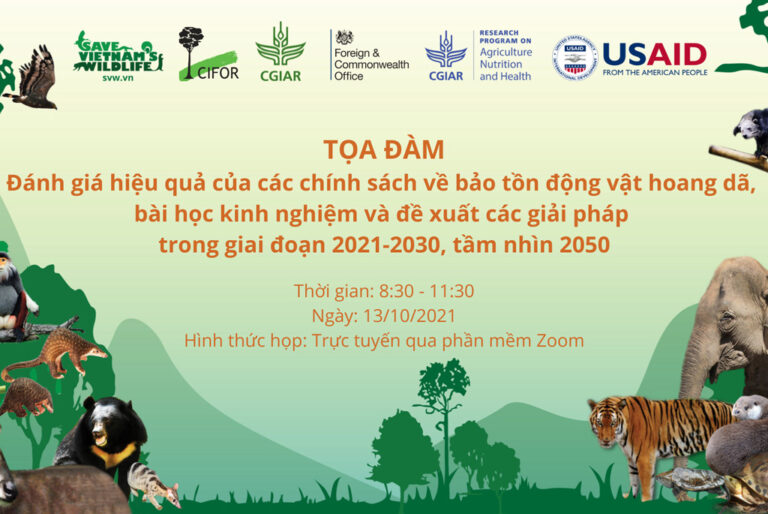
On the morning of October 13, 2021, an online seminar titled “Evaluating the Effectiveness of Wildlife Conservation Policies: Lessons Learned and Proposed Solutions for the 2021-2030 Period, with a Vision to 2050,” organized by Save Vietnam’s Wildlife (SVW) in collaboration with the Center for International Forestry Research (CIFOR), was successfully held. The seminar saw over 100 delegates participate via Zoom, with hundreds more following the livestream on the Facebook page of Save Vietnam’s Wildlife (SVW).
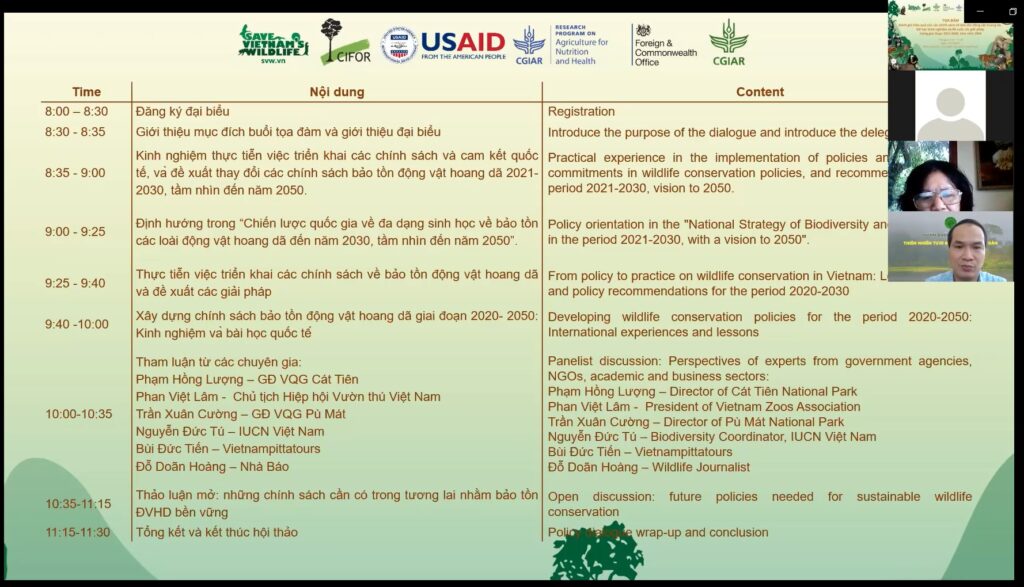
The seminar featured consultations and contributions from experts regarding the effectiveness, existing challenges, domestic and international lessons learned, and proposed policy changes for wildlife conservation. This is particularly relevant given the negative impacts of the COVID-19 pandemic on social activities. Evaluating these policies and proposing appropriate adjustments will not only support wildlife conservation efforts but also help achieve the goals set out in forestry development and biodiversity conservation strategies for the 2021-2030 period, with a vision to 2050.

The seminar provided critical recommendations for guiding future wildlife conservation policies, including:
– Wildlife conservation policies should move toward clear criteria for the commercial breeding of wildlife, with the goal of issuing a list of species permitted for commercial farming.
– Establish criteria to ensure that decisions regarding the farming of any species are based on a comprehensive assessment of economic impacts and species conservation.
– Enforcement against violations should not be limited to the Forest Protection Department but should also involve local authorities (such as commune police).
– CITES implementation is not solely the responsibility of the CITES Management Authority of Vietnam; policies must adopt a multi-sectoral approach.
– Work toward developing a dedicated Law on Wildlife Conservation to unify the management of biodiversity and wildlife from the species level to the ecosystem level. This would harmonize legal sanctions for wildlife violations—ranging from administrative to criminal—to avoid the current fragmentation where only a few clauses exist in the Penal Code and administrative penalties are scattered across various decrees. This will also help mobilize resources, prevent overlap, and improve the efficiency and effectiveness of enacted policies.
– Establish regulations for rescue centers, including standards to ensure transparency and animal welfare. Limit the use of rescued animals for exhibition purposes, and balance revenue generation with conservation and animal welfare needs.
– Wildlife management officials at all levels of government should be more proactive in investigation and enforcement. While journalists can assist in investigations, the primary responsibility remains with state agencies.
– Compensation for wildlife management staff should be improved. Conservation areas continue to face significant difficulties in accessing budgets to maintain operations and expand the scale of wildlife rescue and conservation efforts.
– Staff downsizing should be based on the scale of the conservation area rather than a mechanical mechanism that fails to account for the protected area size of each individual site.
– Procedures related to the management of public assets involving wildlife should be streamlined and improved.
– Ecotourism is considered an effective tool for contributing to sustainable development, wildlife conservation, and livelihoods for communities living around forests.
– Develop new financial mechanisms to promote economic development alongside forest and wildlife protection (e.g., payments for environmental services, carbon credit trading, deforestation-free business, stocks, bonds, etc.).
– Tax reduction policies for businesses that contribute and donate to social and environmental organizations.
Seminar materials:
Developing wildlife conservation policies for the 2020-2050 period: International experiences and lessons, Dr. Pham Thu Thuy – CIFOR
Experiences and policy directions for wildlife conservation in Vietnam, 2020–2030 period, vision to 2050, Dr. Vuong Tien Manh – Deputy Director of CITES Vietnam
From policy to practice in wildlife conservation in Vietnam: Lessons learned and policy recommendations for the 2020–2030 period (updating), Nguyen Van Thai – Director of SVW