


PANGOLIN
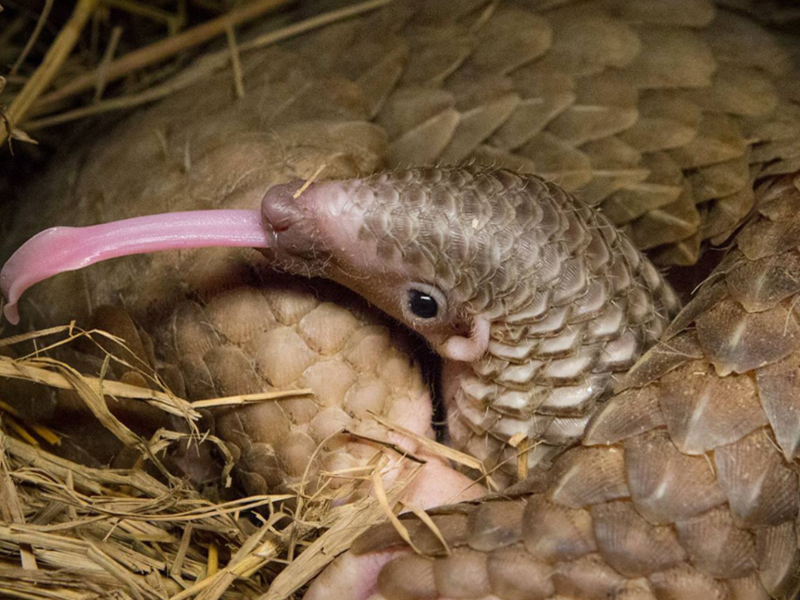
Species information
Pangolins are the only mammals in the world covered in hard scales.
Pangolins are nocturnal and forage at night.
Pangolins can curl into a ball to protect themselves from predators. They have no teeth and use their long, sticky tongues to eat ants and termites—their favorite food in the wild.
A pangolin can eat 200,000 ants a day.
Pangolins give birth to live young and nurse them with milk. Pangolin pups often ride on their mother's tail while she moves and forages at night.
There are eight species of pangolins in the world: four in Asia and four in Africa. Vietnam is home to two species: the Sunda pangolin and the Chinese pangolin, both of which are facing the threat of extinction.
Geographic distribution
Sunda Pangolin
Habitat and distribution: primary and secondary forests, including lowland dipterocarp forests and human-impacted areas. In Vietnam, the Sunda pangolin is found in a variety of habitats, particularly in areas with primary forest.
In Vietnam: from Nghe An to the southern provinces.
Worldwide: Brunei, Cambodia, Laos, Malaysia, Myanmar, Indonesia, Vietnam, Singapore, and Thailand.
Chinese Pangolin
Habitat and distribution: a wide range of habitats, including primary and secondary tropical forests, limestone areas, broadleaf and coniferous forests, bamboo forests, grasslands, and fields.
In Vietnam: from the northern provinces down to Nghe An.
Worldwide: Bangladesh, India, Laos, Myanmar, Nepal, Taiwan, Thailand, China, and Vietnam.
Threat level


The IUCN Red List categories and criteria are designed to be an easily understood and universal system for classifying species at risk of global extinction. The system divides species into nine categories: Not Evaluated, Data Deficient, Least Concern, Near Threatened, Vulnerable, Endangered, Critically Endangered, Extinct in the Wild, and Extinct.
Both pangolin species in Vietnam are listed as Critically Endangered on the IUCN Red List. The other six pangolin species are also threatened.
The greatest threat to pangolins is humans.
Pangolins are the most trafficked mammals in the world. Every year, more than 100,000 are poached from the wild for illegal trade, primarily for their scales used in traditional medicine and for their meat.
What is SVW doing to conserve pangolins in Vietnam?
1,726
Pangolins rescued
1,070
Pangolins released back into the wild

Rescue and rehabilitation of Owston's civets
Habitat research and threat assessment for wild Owston's civets
Conservation breeding of Owston's civets
Managing captive populations in Vietnam to minimize the risk of disease outbreaks