
SVW Develops Ex-Situ Conservation Breeding Program
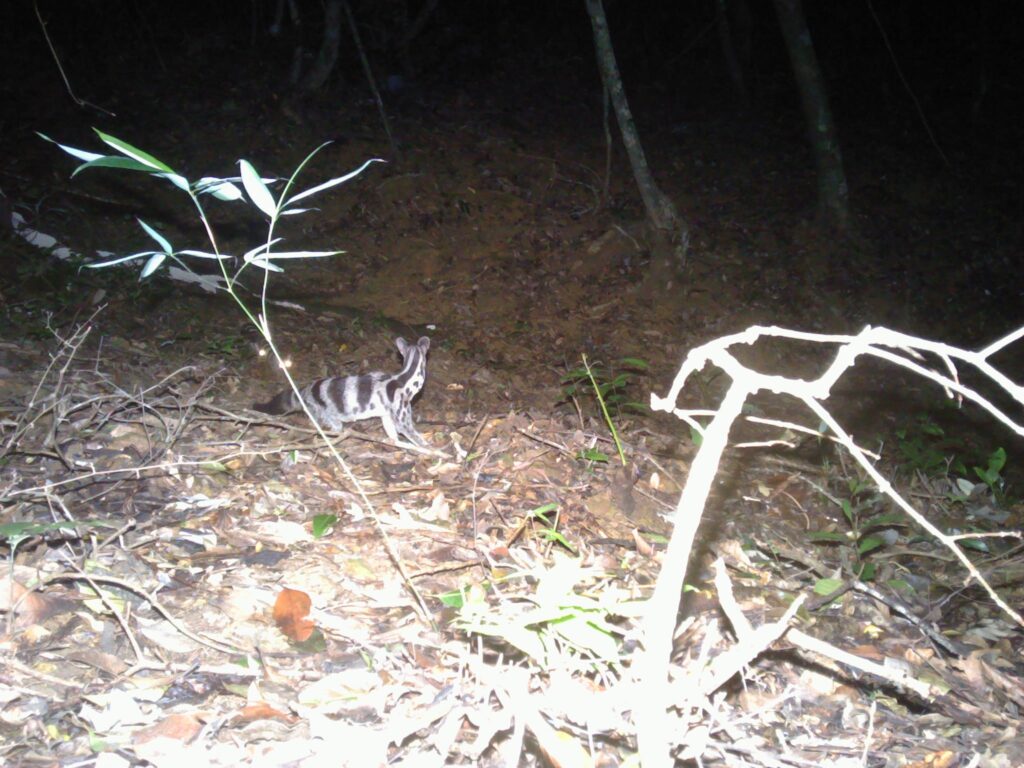
Recently, our camera traps captured footage of a mother Owston’s civet and her cub in a protected area in Vietnam in August 2021. Every time we spot a mother and offspring of an endangered wildlife species, we feel incredibly happy. It is heartening to know that many individuals of that species are still able to reproduce and thrive, even though such sightings are becoming increasingly rare.
The Owston’s civet is endemic to Indochina, classified as Endangered by the International Union for Conservation of Nature (IUCN), and protected under Vietnamese law (Decrees 64/2019/ND-CP and 06/2019/ND-CP). This species is primarily distributed across Vietnam, Laos, and the southern tip of China.
Ex-situ conservation breeding programs—breeding and developing populations outside their natural habitat—are essential to the conservation strategies for many endangered species in Vietnam. This is also one of the priority actions proposed in the Owston’s Civet Conservation Strategy 2019–2029: https://www.cpsg.org/content/conservation-strategy-owstons-civet-chrotogale-owstoni-2019-2029-english
Here are some reasons why conservation breeding programs are necessary:
– The number of individuals in the wild is critically low or continues to decline across their entire range. The chances of mature individuals meeting during the breeding season are so low that the population cannot grow;
– The species continues to face significant pressure from poaching and the loss, degradation, and fragmentation of its habitat. These issues cannot be resolved overnight;
– When wild populations drop to critical levels, captive-bred individuals can be reintroduced to supplement the population and provide genetic diversity.
SVW is currently one of the few organizations in Vietnam implementing conservation breeding programs. We focus primarily on two species: the Owston’s civet and the Sunda pangolin.
Drawing on our experience and capabilities, SVW aims to build a dedicated conservation breeding center for these two species to minimize the risk of cross-species disease transmission and improve breeding success. We are currently working urgently to finalize the program proposals and necessary documentation so that the project can be launched as soon as possible.
Many conservation organizations worldwide have implemented breeding programs for endangered species, and they have identified several key challenges:
– The costs of such programs are often very high.
– Many individuals kept in captivity for long periods struggle to survive once reintroduced into the wild.
– Habitats continue to be degraded, and individuals remain at risk of poaching.
Some organizations have successfully implemented reintroduction programs, such as the Black-footed ferret conservation program in the United States.
We are doing our best, learning from both successes and failures, to help restore the populations of these two endangered species.